
1948 Wheat Penny and Color: When Red Actually Matters
In the late 1940s, U.S. coinage had already returned to peacetime metal standards. Wartime steel cents were gone. By 1948, production was stable, demand was high, and coinage flowed normally into circulation.
When people search for the 1948 Wheat penny value, they often expect a rarity story. They expect a hidden key date. That expectation rarely matches reality.
The 1948 issue is not a key date. It is not a semi-key. Its interest lies elsewhere. For this year, surface preservation and color matter more than mintage totals.
Basic Specifications
Before discussing value, confirm the fundamentals.
Feature | Detail |
Year | 1948 |
Mints | Philadelphia, Denver (D), San Francisco (S) |
Composition | 95% copper, 5% tin & zinc |
Weight | 3.11 g |
Diameter | 19.05 mm |
Edge | Plain |
Obverse | Abraham Lincoln |
Reverse | Wheat ears |
The alloy is standard: there is no steel, no wartime substitution, and no silver content.
Weight and diameter rarely vary unless the coin is damaged. Large deviation usually signals post-mint alteration, not rarity. Identification is straightforward. The complexity begins with condition and color.
Mintage Context: Why 1948 Is Not Rare
Approximate mintages:
Mint | Mintage (approx.) |
1948 (P) | ~217 million |
1948-D | ~172 million |
1948-S | ~65 million |
As you see, all three mints produced large numbers.
Philadelphia struck the highest volume. Denver followed closely. San Francisco shows the lowest total but remains common in circulated grades.
To put this in perspective:
1909-S VDB: under 500,000
1914-D: just over 1 million
1931-S: under 900,000
Compared to those, 1948 is abundant. Large output explains why most examples survive today. The year does not command a date premium. Scarcity is not the story here.
The Real Variable: Copper Surface and Color
Copper reacts. It oxidizes. It changes tone over time.
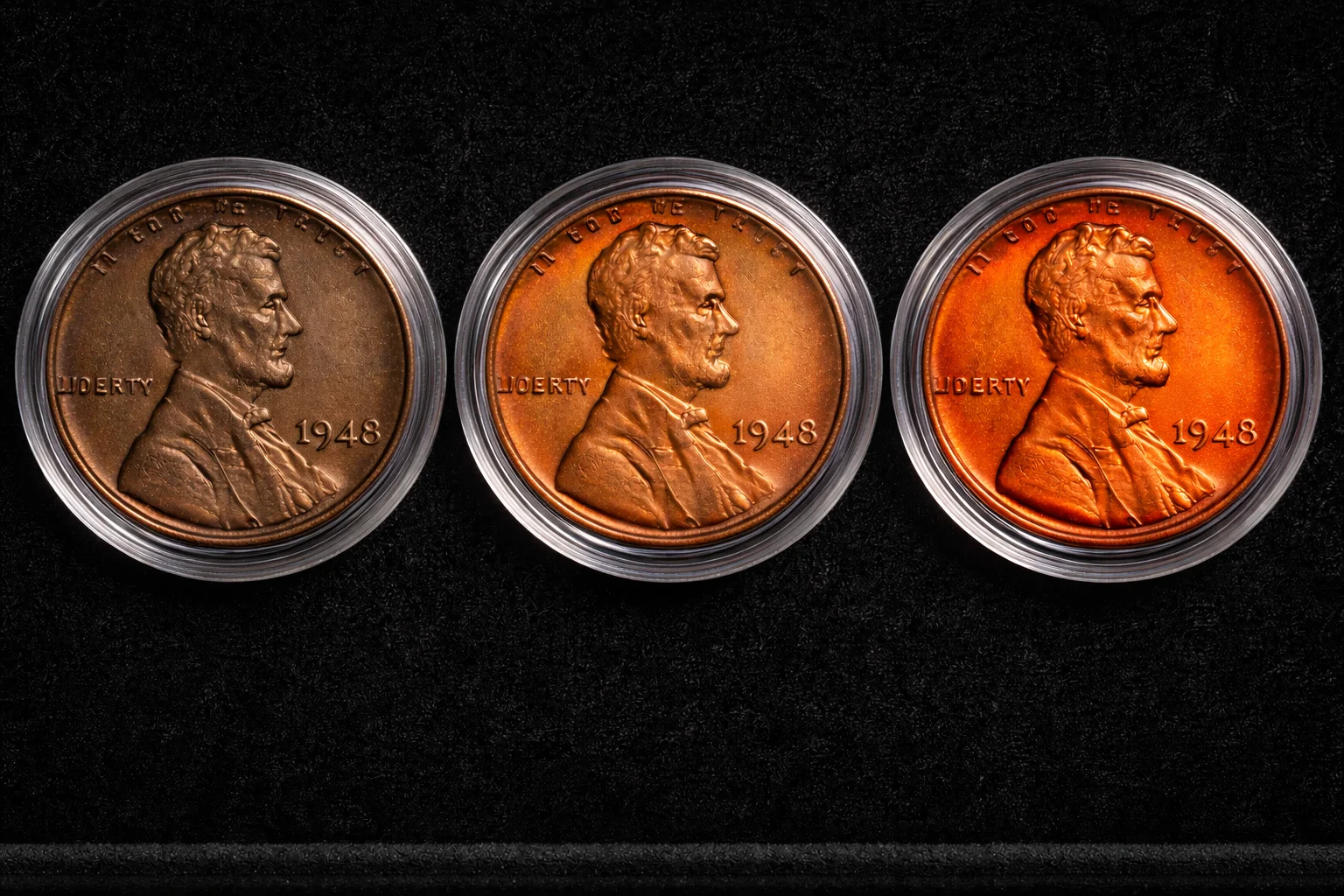
Color grading for uncirculated wheat cents follows three main designations:
Brown (BN): Full brown surface. Original red is gone. Oxidation is complete.
Red Brown (RB): Mixed surface. Partial red remains. Brown areas are visible.
Red (RD): Strong original mint red across most of the coin.
This classification affects value sharply in Mint State grades.
In circulated condition, color matters less. Once wear appears, red surfaces fade quickly. The distinction becomes critical only in higher grades.
Why Red Brings a Premium
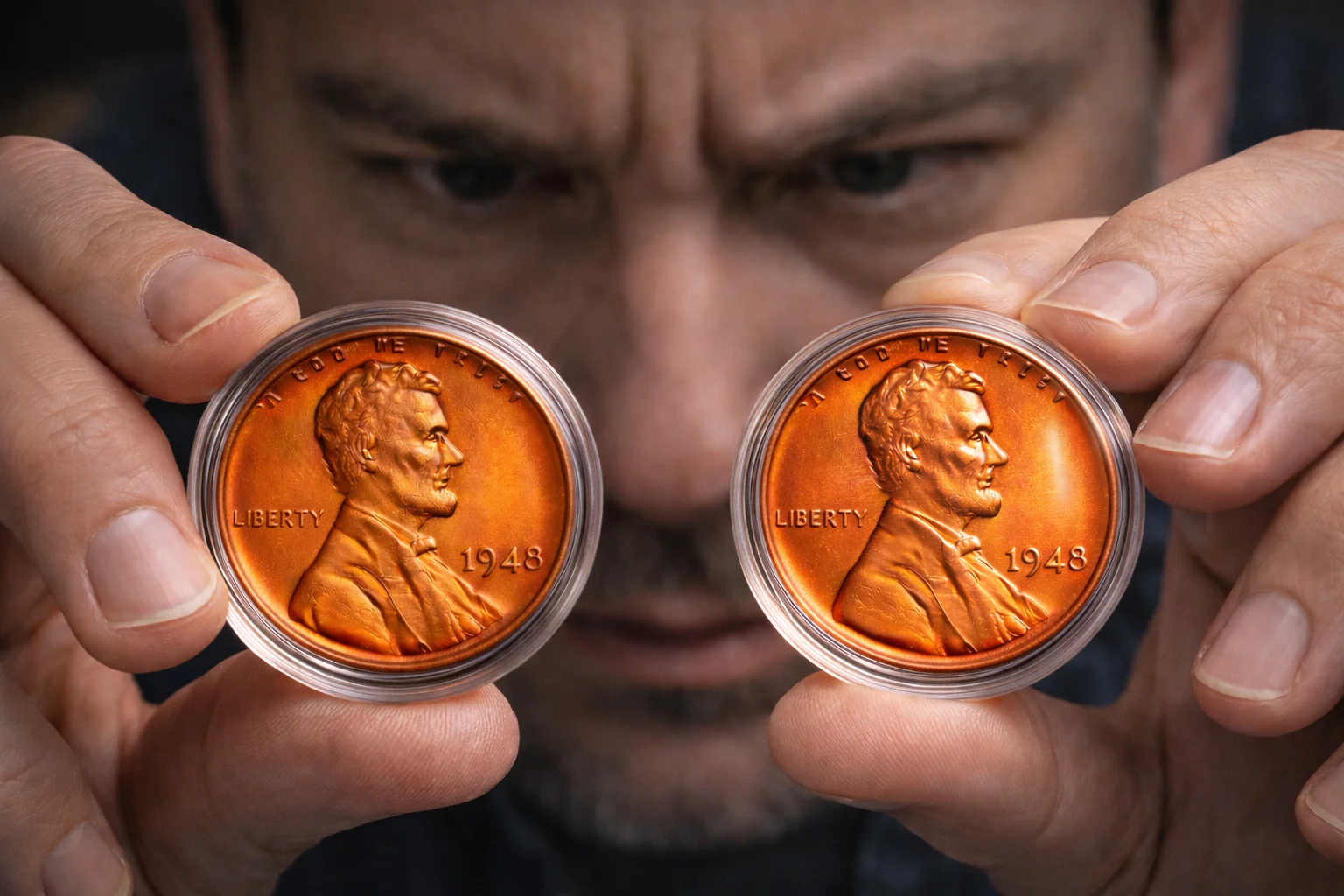
Fresh copper reflects light differently. It carries a bright, orange-red glow. That tone signals minimal exposure to air and minimal disturbance.
As copper oxidizes, it darkens. This is natural and expected. Brown tone alone does not reduce collectibility. But in Mint State grades, collectors compete for preserved red examples.
An MS65 BN may sell for modest amounts, but a MS65 RD may sell for several times more. The difference lies in originality.
Why Cleaning Destroys Value
Copper surfaces form a microscopic structure during striking. Luster flows outward from the center. When a coin is cleaned, that structure changes.
Cleaning removes surface film. It often leaves faint hairlines. Under magnification, the texture looks disturbed. Light reflects unevenly.
The coin may appear brighter at first glance. In reality, market confidence drops.
Original surfaces matter more than brightness.
Practical Price Spread: Color vs Grade
Below is a simplified comparison for standard, non-error pieces.
Grade | BN | RB | RD |
MS65 | moderate | higher | strong |
MS66 | higher | strong | much higher |
MS67+ | scarce | scarce | premium tier |
At MS67 RD, prices can exceed $1,000 depending on eye appeal and population levels.
Small spotting reduces value sharply. Uneven color lowers demand. Full, even red surfaces attract competition.
The jump from MS66 to MS67 can be dramatic. Not because of the date, but because of preservation quality.
When Errors Override Color
Sometimes color is not the main driver. Clear mint errors can outweigh surface tone.
Before evaluating a specific coin, it helps to know what varieties were documented for this year.
Main 1948 Wheat Penny Errors
Error Type | What to Look For | General Market Range* |
Repunched Mint Mark (RPM) | Secondary mint letter visible | $40–$250+ |
1948-S/S RPM | Overlapping S mint marks | $50–$300+ |
Doubled Die Obverse (DDO) | Doubling in date or LIBERTY | $80–$400+ |
Letters Touching Rim | “L” or date digit near edge | $20–$150 |
Lamination Error | Peeling or split copper surface | $40–$300+ |
Partial Collar | Edge distortion from misalignment | $60–$200 |
Struck Through | Foreign material impression | $50–$500+ |
*Ranges vary by clarity, grade, and demand.
Understanding These Errors
Repunched Mint Marks (RPM)
The mint mark was applied by hand to the working die. Sometimes it was punched more than once. Clear secondary impressions create collectible varieties. These are most often seen on Denver and San Francisco coins.
Doubled Die Obverse (DDO)
True doubled dies form during hubbing of the die. Look for clear separation in letters or numbers. Machine doubling appears flat and shelf-like. It does not carry strong premiums.
Letters on Rim
In some cases, “L” in LIBERTY or parts of the date appear very close to the rim. Slight die misalignment can cause this effect. Strong examples attract attention. Minor shifts are common.
Lamination Errors
Improper alloy mixing can lead to surface splits or peeling layers. The metal appears to separate in streaks. These errors are linked to stress in the bronze strip before striking.
Struck Through
Debris between the die and the planchet can leave impressions. Large struck-through areas draw stronger premiums than faint disturbances.
Market prices vary widely on online platforms. Strong visibility, sharp detail, and higher grade increase value. Weak examples remain modest.
High-Grade Market Reality
In circulated grades, 1948 cents remain common.
In Mint State, the story changes.
MS66 RD coins are desirable but available. MS67 RD pieces are much scarcer.
Population reports show steep drop-offs at the highest levels. Surface quality becomes critical. Tiny ticks can reduce a grade.
Eye appeal matters. Even within the same numeric grade, cleaner fields and even color command stronger bids.
In this year, grade value dominates date value.
Practical Evaluation Steps
A collector should follow a structured approach:
Confirm mint and authenticity.
Weigh the coin. Check diameter.
Examine color under neutral light.
Tilt the coin to observe luster flow.
Inspect high points for wear.
Use magnification for RPM or DDO.
For quick verification of year, mint, and basic specifications, a coin scanner app can assist. Coin ID Scanner helps confirm the type and organize images for comparison. It supports identification and record keeping.
Frequently Asked Questions
Is 1948 a key date?
No. Production was high across all mints.
Is 1948-S rare?
It has the lowest mintage of the year but remains widely available in circulated grades.
Does full red always mean high value?
Only in higher Mint State levels. Red color in AU does not create large premiums.
Are RPM varieties common?
They exist, especially on D and S coins. Strong examples are less common than minor shifts.
Can brown coins regain red color?
No. Oxidation is permanent. Artificial alteration harms value.
Is lamination damage always valuable?
Only when clearly caused during production. Post-mint damage does not qualify.
Should I grade a 1948 RD coin?
If it appears near MS66 or better and surfaces are clean, professional grading may be justified.
Do minor rim touches add value?
Small alignment shifts often bring modest premiums. Strong, clear cases perform better.
Final Assessment
The 1948 wheat cent is not a key date. It is not a semi-key. Its importance lies in:
Strong Mint State potential
Color sensitivity in higher grades
Interesting RPM and DDO varieties
Stable post-war copper composition
Age alone does not place it among coins worth money. Condition, originality, and error clarity determine the premium.
This year teaches a simple lesson. High mintage does not eliminate opportunity. It shifts attention toward preservation. When red truly survives, it matters.